
The Eye Who Held A Universe: Oculan
Coming 2026
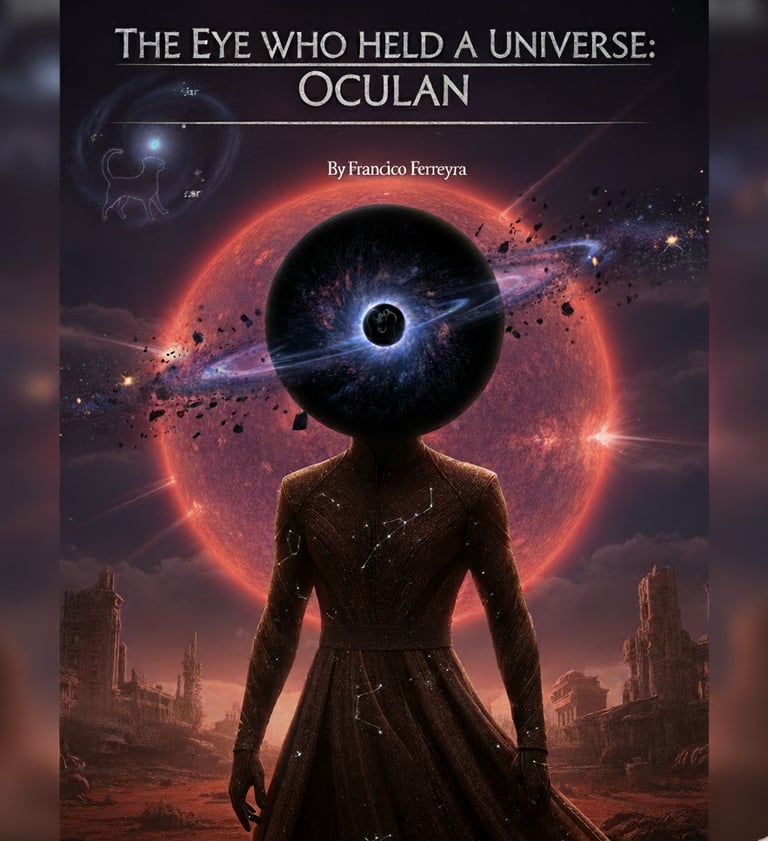
"To Oculan, light was never golden—it was a theorem to be solved. Music was not a melody, but a jagged waveform scraping against his internal registers. Born from the violent collision of a supernova mother and a comet father, he is a living eye of obsidian with a singularity for a heart. He carries ten billion histories in his dark vault, yet he cannot feel the simple warmth of a human hand. Oculan is the universe’s most perfect observer, and its most lonely prisoner."
Chapter 1: The Cosmic Sentinel and the Prismatic Torment
Oculan watched a dying sun the way a child watches a candle gutter—fascinated, helpless, and aching to cup the warmth. Out in the freezing vacuum, the star was a bloated, bruised purple, its surface sloughing off in great, silent curtains of fire. To any other observer, it was a grand celestial event; to Oculan, it was a tragedy he was forced to count, photon by agonizing photon.
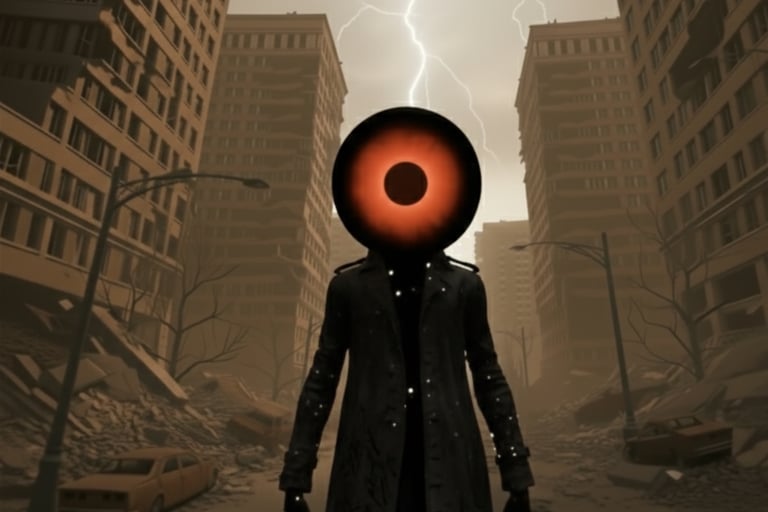
He was not a face born of flesh and bone, but a skull of polished, abyssal obsidian—a seamless orb that didn’t reflect the light of distant galaxies so much as it drank it. The surface of his head was so smooth it appeared liquid, yet it was harder than any diamond. At the precise, geometric center of this head sat a tiny, all-consuming black hole. This was his singularity. It served as his mouth, his ears, and the primary engine of his perception. It didn’t merely "see" the universe; it inhaled it. It swallowed the low, lonely hiss of radio waves and the high, screaming photons of collapsing nebulas, pulling them into a lightless gullet. Inside that dark furnace, the vibrant, chaotic colors of the cosmos were stripped of their beauty and reduced into cold, indexed strings of binary data.
To Oculan, light was never "golden" or "warm"—it was a theorem to be solved. Music was not a melody, but a jagged waveform, its frequencies scraping like sandpaper against his internal registers. Even the most intimate echoes of the universe reached him as math; a lover’s last, desperate whisper, traveling across the void, was nothing more than a sterile set of probability matrices. The black hole within him stored these things in a relentless, infinite library of endings. Because the singularity answered to no law of tenderness, it didn’t allow him the mercy of a fading memory. Instead, it forced these records back into his consciousness whole, making him re-experience the universe’s trauma in a high-definition clarity that felt more real than the present moment.
The rules of his existence were etched into the very physics of his obsidian shell—rules that were as simple as they were cruel. The singularity within his skull operated on a predatory logic: it consumed all electromagnetic energy and information within a limited radius. A nearby comet’s glow wasn’t a shimmering sight to behold; it was a meal to be digested, its light pulled into his center until the sky behind him went dark.
More taxing was the way he processed the intangible. Emotions attached to strong signals didn't just move him; they translated into visceral, gravimetric spikes. When he sensed sharp grief or manic joy from a distant world, it didn't just "hurt his feelings"—it sent physical tremors surging through his event horizon, making his very form vibrate with the weight of someone else's life. He possessed the power to contract himself, drawing his presence inward to shrink his outward footprint until he was almost invisible to the universe’s sensors, but the act was an agony of compression. It was the feeling of a mountain trying to collapse into a grain of sand. It left him hollow, his senses absolute and blunt, revealing the raw, shivering mechanics of everything while softening absolutely nothing.
He carried ten billion histories in that dark vault, but for the reader, it was enough to know the weight of one. He replayed a moon-poet’s final stanza until the lines felt like shards of glass grinding in his mind. The syllables arrived in his consciousness not as poetry, but as a crystalline data packet: the exact frequency of the vowels, the specific chemical composition of the poet’s dying atmosphere, and the precise, stuttering oscillation of the man's heart as it skipped its final beat. Oculan could recall the pattern with a mathematical perfection that could rebuild the moment atom by atom, but he could not recall the actual warmth of the poet’s breath against a cold night.
The memory was an ache without a hand to hold it. He flinched—a phantom reflex with no skin to feel the air—reaching out for a single, ridiculous instant toward a heat he had forgotten how to keep.
This was his eternal torment: to possess all knowledge, yet be denied uncomplicated sensation. To him, a symphony was merely a resolved algorithm; the delicate scent of a flower was nothing but a sterile table of molecular weights and carbon bonds. He could measure the heat of a sun in photon kinetic energy, calculating the exact pressure it exerted on his shell, yet he could not feel the simple comfort of "warmth." The singularity’s filter turned every miracle of the universe into a tidy, fatal clarity—and in doing so, it stole the softness out of existence.
Yet, deep within the obsidian core of his being, he wanted one thing with a hunger that defied his cold programming: a single, unmediated warmth—simple, human, and dumb with feeling. If his library catalogued the magnificent deaths of stars, his heart yearned for the small, messy gravity of being held. He craved the blurring of the senses that made life bearable—the palm on a cheek, the quiet grace of a shared breath, the messy gravity of being loved.
Coming 2026